.svg)



.jpg)
Guild Wars Is Coming to Guild of Guardians
For the first time in Guild of Guardians, your entire Guild will march to war together — fighting, strategising, and conquering a living territory map against three rival Guilds. This is the competitive mode we have been building toward, and we are bringing it to Commanders in beta so we can shape it together.
What Is Guild Wars?
Guild Wars is GoG's first Guild vs. Guild competitive game mode — a seasonal, territory-control battle where four matched Guilds compete across a shared map for seven days. Every member of your Guild has a role to play: building squads, attacking rival territories, and defending the ground you have already claimed.
This is not a solo endeavour. Guild Wars is designed from the ground up around collective strategy. The Guilds that coordinate, communicate, and commit their full roster will be the ones standing at the top of the leaderboard when the season ends.
We are launching Guild Wars as a beta. That means Commanders will be among the first to experience the mode, and their feedback will directly shape what it becomes. The core gameplay is solid and ready to compete in — what follows is a full breakdown of exactly how it works.
-- -- -- --
Beta Notice
Guild Wars is launching in beta on the 8th of April, 2026. The core competitive loop is mostly playable at this stage. We will be monitoring performance, gathering Commander feedback, and iterating on the mode between beta seasons. Specific details — such as the final rewards, match making systems, ranking systems, maps, and gameplay modifiers — will be rolled out over the coming seasons and communicated ahead of the official launch date, which will be announced separately.
-- -- -- --
The Battlefield: Understanding the Map
At the heart of Guild Wars is a shared territory map that all four competing Guilds can see from the moment the season begins. This map is not decorative — it is the strategic playing field where every decision your Guild makes will play out in real time.
On Day 1 of each season, the full map is revealed. Your Guild will use this time to assess the terrain, identify targets, plan attack routes, and configure your squads before combat opens on Day 2.
Node Types
The map is made up of nodes — key positions that Guilds fight to control. There are three types:
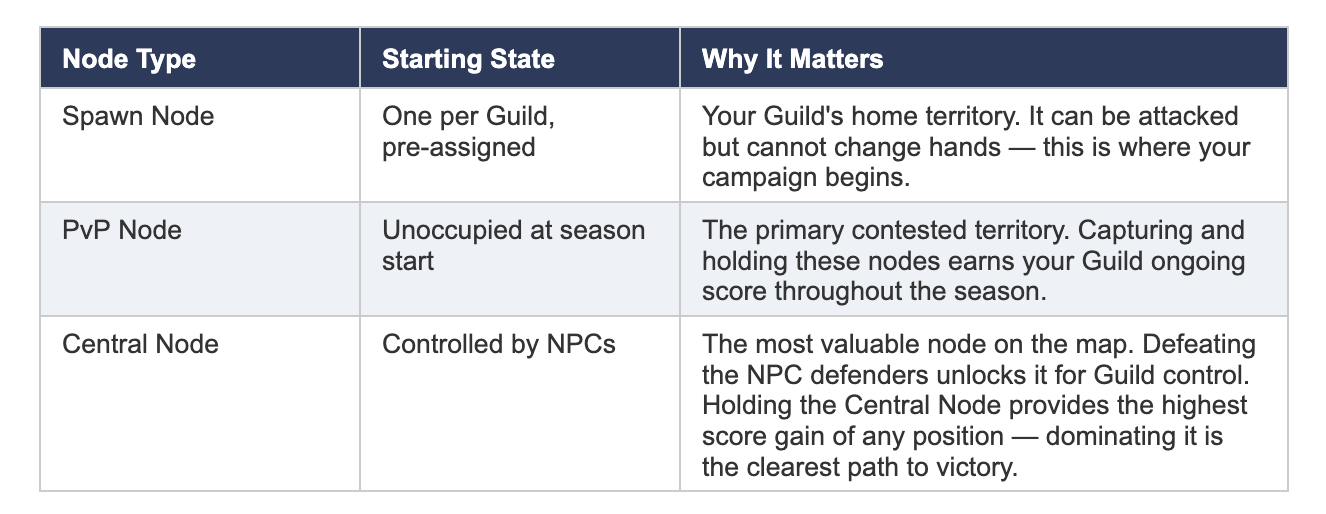
To move deeper into the map and attack more valuable nodes, your Guild must first establish control over adjacent territory. You cannot reach the Central Node without first fighting your way through the surrounding PvP Nodes — making early map positioning a critical decision.
Matchmaking: How Guilds Are Grouped
Each Guild Wars season begins with matchmaking. Four Guilds are brought together into a single match, and competition plays out entirely within that group across the seven-day season. Eligibility: A Guild must have ≥5 active members within the past 7 days (to satisfy
Matchmaking is built to create fair, meaningful competition. The system considers three factors when grouping Guilds:
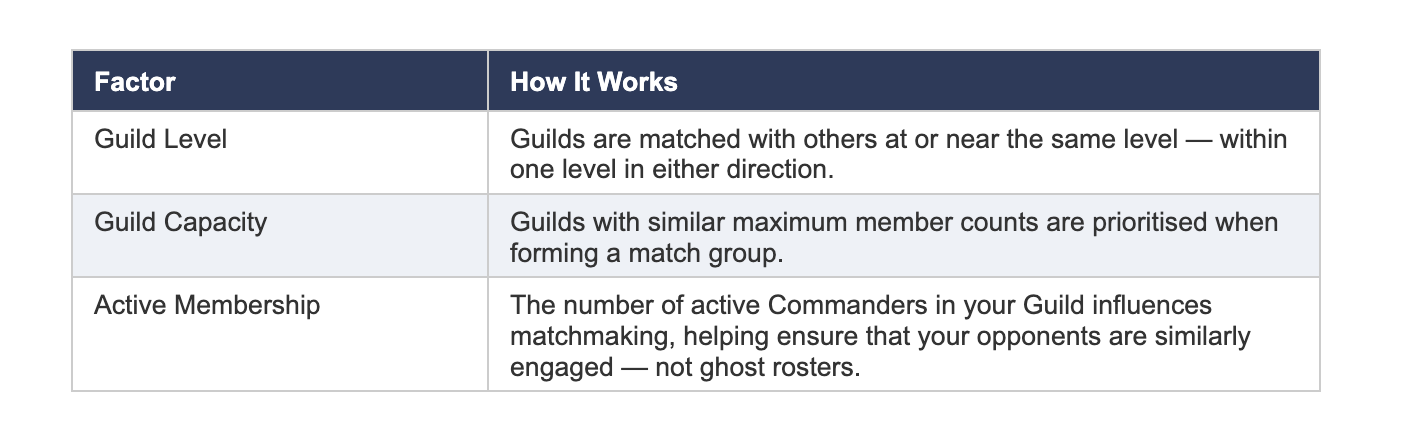
The goal is simple: every Guild Wars match should feel contested. Commanders who show up and fight should be doing so against opponents who are doing the same.
The Season Structure: Seven Days of War
Each Guild Wars season runs for seven days. The structure is designed to give Guilds time to plan before combat opens, and then sustain meaningful engagement across the full duration of the season.
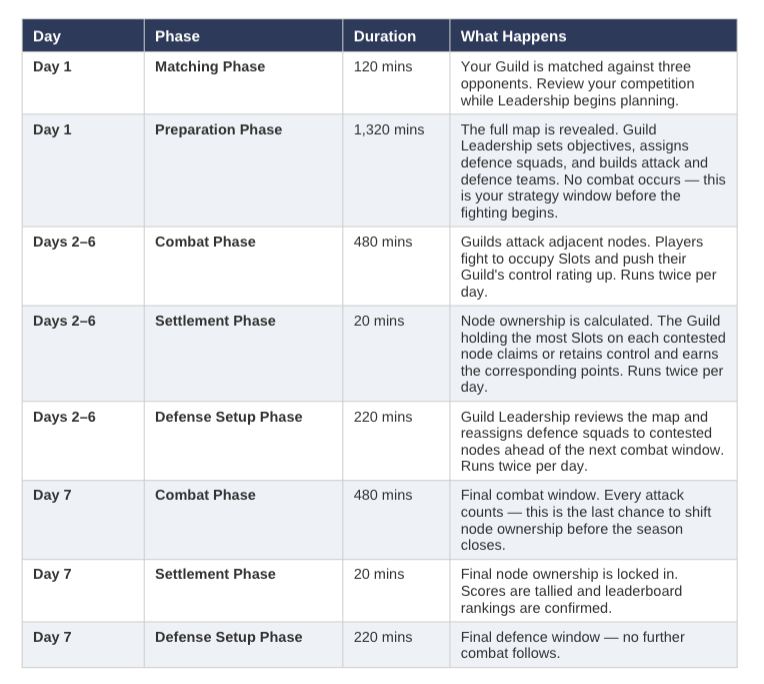

Within the Combat phase, node control is calculated in six-hour rounds. The Guild that accumulates the most score in a given round claims — or retains — control of that node. Staying active and coordinating your attacks around these windows is where the tactical depth of Guild Wars lives.
Combat: How Battles Play Out
Guild Wars combat is a gauntlet. When a Commander attacks a node, they are not fighting a single battle — they are fighting every defending squad on that node, back to back, with no healing or energy resets between encounters.
This makes squad composition and preparation critical. A poorly built attack squad will fall before it can make a dent. A strong, well-considered team can tear through an entire node's defence and shift the control balance significantly in your Guild's favour.
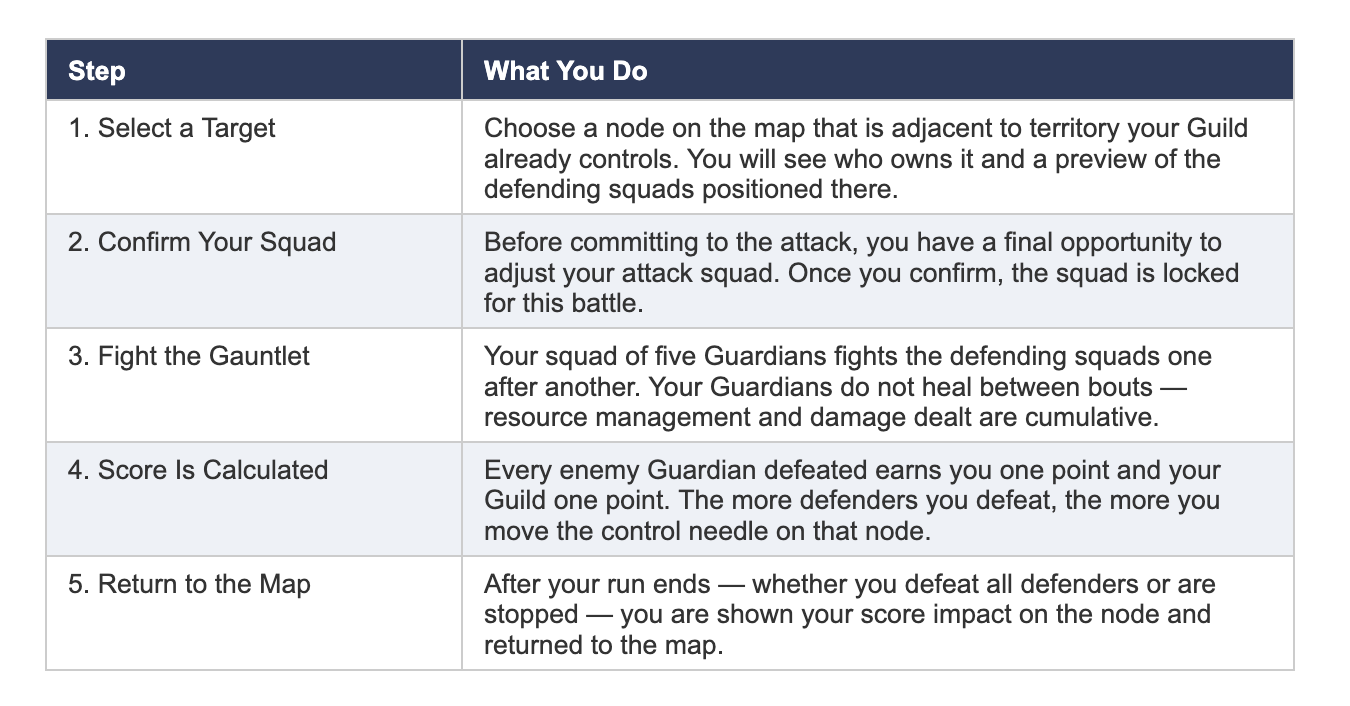
Attacking a Node
Here is the full flow of an attack action:
Node Control
At the end of each combat window, the map settles — and control of every contested node is recalculated based on one thing: Slots.
Each node contains a fixed number of Slots. Whichever Guild occupies the most Slots on a node when Settlement arrives will claim ownership of that node and earn the points that come with it.
The tie-break rule is straightforward: if control of a node's Slots is split evenly between two or more Guilds and no single Guild holds a numerical advantage, ownership does not change. The Guild that held the node going into that combat window keeps it.
To put that into practice — say Node A has three Slots and is currently owned by Guild A. During the Combat Phase, Guild B and Guild C each occupy one Slot, and Guild A holds the remaining one. All three Guilds control one Slot apiece. No one has the majority. At Settlement, Node A stays in Guild A's hands.
Holding a node is not just about attacking — it is about occupying enough of it that your rivals cannot match your footprint. One more Slot than the competition is all it takes.
Defence: Holding What You Have Won
Attacking is only half of Guild Wars. Once your Guild controls a node, that node becomes a target — and defence determines how long you keep it.
Defence in Guild Wars is asynchronous. Defending squads are deployed and fight automatically when challengers arrive. As a defending Commander, you do not need to be online when an attack occurs — your squad fights in your absence.
Each node that your Guild controls has slots for defending squads. Guild Leadership assigns Commanders to defend specific nodes, and those Commanders configure their best defensive team to hold the position. When a defending squad is defeated, the Commander and Guild Leadership are notified immediately — giving your team the signal to respond, reassign, or reinforce.
Commanders can only defend one node at a time, so Leadership must be deliberate about where strength is deployed. Spreading defensive resources too thin is one of the most common ways Guilds lose ground they have already fought for.
Leadership & Strategy: Your Guild's Competitive Edge
Guild Wars gives Leadership — Guild Leaders, Vice-Leaders, and Elders — a meaningful set of strategic tools that directly influence how well the Guild performs. Commanders who step into these roles will find Guild Wars to be a richer experience for it.
Setting Focus Objectives
At any point during the season, Guild Leadership can designate up to two nodes on the map as Focus targets. When members attack a Focus node, they earn bonus score — both personally and for the Guild. Coordinating Focus designations with active combat windows is one of the highest-leverage decisions Leadership can make during a season.
Managing Defence Assignments
Leadership assigns Guild members to defend controlled nodes and sets the order in which attacking teams will face those defenders. Positioning your highest-power Commanders at the front of a defence line means challengers must work harder to break through — protecting your most important nodes.
Squad Building
All Commanders — Leadership and members alike — are responsible for configuring both an attack squad and a defence squad at the start of each season round. These squads can be adjusted at any time, but changes do not take effect immediately if a squad is already mid-battle or committed to an active defence assignment. Plan ahead.
This is where having a deep Guardian roster becomes a genuine competitive advantage. Commanders who have invested in multiple high-power squads will be able to sustain more attacks, defend more nodes, and contribute more score over the course of a seven-day season.
Scoring, Rankings, and Leaderboards
Guild Wars tracks performance at two levels simultaneously: Guild and individual. Both matter, and strong individual performance is what fuels Guild success.
How Score Works
Every enemy Guardian your attack squad defeats earns you one personal point and your Guild one Guild point. Score is simple, direct, and tied entirely to combat performance. The Commanders and Guilds that attack the most, and attack effectively, will accumulate the most score.
Leaderboard Types
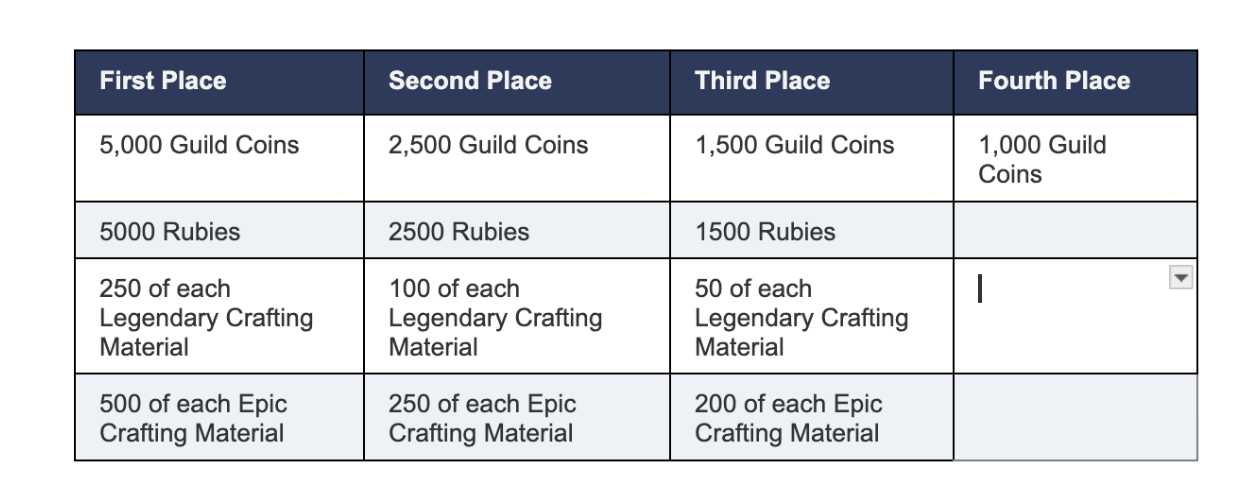
At the close of each season, four leaderboards will determine your standings:
Leaderboard

What to Expect from the Beta
Guild Wars is the most ambitious competitive mode we have built for Guild of Guardians and still needs a lot of work before it’s ready for an official release. We are launching it in beta because we want Commanders in the thick of it — testing it, stressing it, and helping us understand what is working and what needs sharpening.
The core loop is playable: basic matchmaking, a common map, combat assignment, defence management, simplistic scoring, and a Guild focused leaderboard are all available to engage with. What we want from the beta is real data and feedback on how yall are playing. We know lots of stuff still needs to be finished, but some things really just need a trial run before they can be perfected.
Prepare Your Guild
Guild Wars will reward the Guilds that show up ready. Day 1 of the season is your preparation window — and how your Guild uses it will set the tone for everything that follows.
Talk to your Guild. Build your squads. Know your map.
The launch date will be announced ASAP — keep an eye on our official channels for the confirmation. Until then: Forge your legacy.